History

The record of Muñoz, told three ways: as a book to page through, as moments in the order they happened, and in the words of the people who lived them.

Flipbook

Turn the pages: click a page, use the arrow keys, or drag a leaf across.

HISTORY

FROM SITIO TO BARRIO

In 1886, Papaya was changed into ‘Muñoz’ to honor Don Francisco Muñoz, the province’s alcalde mayor, and the community’s first appointed gobernadorcillo. Muñoz was annexed as a barrio of San Juan de Guimba municipality. Settlers trickled in from Bulacan and the Ilocos Region. In 1911, Factoria (now San Isidro town), the provincial capital, was totally flooded. Muñoz was then considered a possible new capital of the province.
       At about the same time, the people of Barrios Muñoz and San Antonio, also in San Juan de Guimba town, and Palusapis in Sto. Domingo municipality, together with Sitios Kabisukulan, Rang-ayan, Mataas na Lupa, Siniguelas, Purok Agrikultura, and Pulong Maragul in Talavera town, were organizing themselves to be separated from their three respective municipalities to become a new independent municipality. They were prepared to construct a municipal hall and a school building for the emerging town.

FROM BARRIO TO TOWN

     Upon recommendation of the Provincial Board of Nueva Ecija, then headed by Governor Isauro Gabaldon, and with approval of then Acting Governor General Newton Gilbert, the organized barrios and sitios were granted independence as a regular municipality on January 10, 1913 under the name of Muñoz. The seat of the

HISTORY

 fledgling municipal government was positioned in erstwhile Barrio Muñoz. Thus, the municipality of Muñoz was born, and steadily grew to become today an Agricultural Science City in-the-making.

     Muñoz owes a tremendous lot to its early leaders Tranquilino Delos Santos, and other homesteaders Luis Ramos, Ambrosio Medina, Cayetano Caisip, Victorino Pornuevo, and Precy Hill Delos Santos. A municipal hall, a church building, and a small public market were erected in Lumang Bayan (now Poblacion North). A road linking the young Muñoz town with the national highway from Barangay Bacal, Talavera was also constructed.

    Muñoz continued to attract more settlers. More barrios were established and were named after their peoples’ ideals and aspirations, landmarks, and personalities such as Rang-ayan (prosperity), Linglingay (recreation), Mangandingay (company), Magtanggol (defense), and
 Villa Isla (in a leader’s honor).

     Muñoz was not spared from the pains of the Second World War. Being the last stronghold of the Japanese Imperial Army while scampering to the Cordilleras, the American liberation offensive razed the town to the ground in a matter of days. But Muñoz has risen from the ashes slowly but surely under its dedicated leaders, and now, as a first-class town, has the full confidence to welcome and prosper further in the third millennium.


HOW IT BECOME A MUNICIPALITY

     More than a century ago, this place we love and now call Muñoz was a densely forested area inhabited by Baluga tribes who settled along the fertile creeks and rivulets of now Barangays Balante, Catalanacan, and Matingkis. The tribes-lorded settlement was then named “Papaya” and a sitio of Barrio San Antonio of the town of Guimba.  With 

HISTORY

the arrival of more Christian immigrants, including the Spanish conquistadores, sitio Papaya metamorphosed into a pueblo in 1855 with Sebastian del Castro as gobernadorcillio. It was then that the pueblo’s catholic devotees endeared San Sebastian as their patron saint, heightening respect for the gobernadorcillio.

     In 1886, Papaya was changed into “Muñoz to honor Don Francisco Muñoz, the province’s alcalde mayor and the community’s first appointed gobernadorcillio. Muñoz was annexed as a barrio of San Juan de Guimba municipality. Settlers tricked in from Bulacan and the Ilocos Region.

    Up to the year 1912, Muñoz and San Antonio were barrios or small villages of the town of San Juan de Guimba (now known as Guimba) and Palusapis was then a barrio of the town of Sto. Domingo. The inhabitant of these three (3) barrios petitioned that their said places together with the “sitios”  (small homelots) of Kabisuculan, Rang-ayan,  Rizal 
Mataas-na-lupa, Sineguelas, Pukoc, Agricultura and Pulong. Maragol of the municipality of Talavera, be separated from their respective municipalities and be organized into an independent municipality.

     Upon the recommendation of the Provincial Board of Nueva Ecija during that time which was then headed by Governor Isauro Gabaldon and pursuant to the provisions of an Act numbered 1748 entitled “An Act authorizing the adjustment of provincial and municipal boundaries and the 23 municipalities of Nueva Ecija at that time was increased to 24 towns by virtue of Executive Order No. 72 dated October 28, 1912, signed and issued by the Government of the Philippine Islands Executive Bureau under the then Acting Governor-General Newton W. Gilbert. However, the said organization of the said three (3) barrios and eight (8) sitios into a new and independent municipality where the seat of government shall be in the barrios of Muñoz, took effect on January 1, 1913. /3 But for some reason or the other, the celebration of the Foundation Day  of Muñoz 

HISTORY

as a town has been observed every January 10.

EARLY CONDITION OF THE MUNICIPALITY

While everybody has the right to development, progress per se is easier said not done for it has to be determinedly labored for in order to achieve the amount or level of success it is aspired.

Although it is true that our early leaders persevered so much for the development of our municipality, the degree of development aspired of was rather slow, attributive perhaps by the subjugation of our nation and our municipality for that matter, by different conquerors on several occasions where the continuity of whatever plans for development then prevailing was put to a stand-still. And, maybe to a large extent, in the dole-out mentality of some if not many of our constituents who seem to be contended in waiting for material assistance from the government 
instead of becoming self-sufficient in his basic needs thru self-help.

Before the advent of the 1990s, our farm-to-market roads were at a pitiful state, potholes were so big that carabaos could wallow in it on rainy days, poor agricultural production because of lack of technology not to mention natural disasters, unemployment was so great that our professionals were forced to seek work abroad, deliveries of basic services were inadequate due to lack of funds, malnutrition was rampant, local annual income was so low (up to 1992) it could ill afford to finance the implementation of even low-cost projects. All of these and many more, not to mention the lackadaisical or Indifferent attitude of government officials to the said plight of the masses especially in the countryside, compound the problem on under-development of our municipality.

Muñoz was not spared from the pains of the Second World War. It was the last stronghold of the 

HISTORY

     Japanese Imperial Army where one of the bloodiest and fiercest battles during World War II in the Philippines ensued. The whole town was practically leveled to the ground where the Japanese Army before scampering to the Cordilleras committed virtually all forms of atrocities. The Battle of Muñoz started on January 31, 1945 at 7:30 AM where Company K of the 20th Infantry of the 6th Infantry Division figured prominently in the liberation of Muñoz. According to war accounts, by February 7, 1945, not a wall or a tree or one Japanese soldier remained standing in Muñoz. For several days after the battle was over smoke of ruins and the stench of death continue to pervade the areas, whatever records/documents stored in the town hall were reduced to ashes. During those 8 days (Jan.31-Feb. 7, 1945) fierce battle, 1,935 Japanese soldiers were annihilated although 1,527 bodies were only found where total casualties from the Liberating Force totaled 97 dead and 303 wounded out of which the 20th Infantry suffered 57 killed and 152 wounded. / 5 Survivor from the Red Star  Division  (20th
 Infantry) used to go on a sentimental visit to our municipality and very recently, September 4, 2000, seven (7) visitors (5 veterans and 2 spouses) paid a visit to Muñoz where a flag raising ceremony/program was dedicated in honor of the gallantry and heroism of those who shed blood, sweat and tears and precious lives during the battle of Muñoz so that we, the living and all the succeeding generations of Muñozonians shall live in freedom.

    Many sets of leadership as Municipal Mayors have succeeded one after the other since the birth of our municipality up to the time of its creation as a Science City, all sharing the common vision and mission to establish a community that is physically, socially, politically, economically and spiritually strong and secured:

EARLY CONDITION OF THE MUNICIPALITY

In July 1992, Engineer Efren L. Alvarez, took over the reigns of the local government unit as Local Chief Executive. His

HISTORY

administration, thru his initiative and pioneering tendencies, was imbued with the overriding objective for total development of the municipality. Thusly, the adoption of the mission to transform Muñoz into a center of Science and Technology, trade, commerce and Agro-industry. How to transmogrify the mission into reality was the nagging question which gave no room for Mayor Efren L. Alvarez and his staff to pause rather ventured into all possible measures towards the realization of the objective.

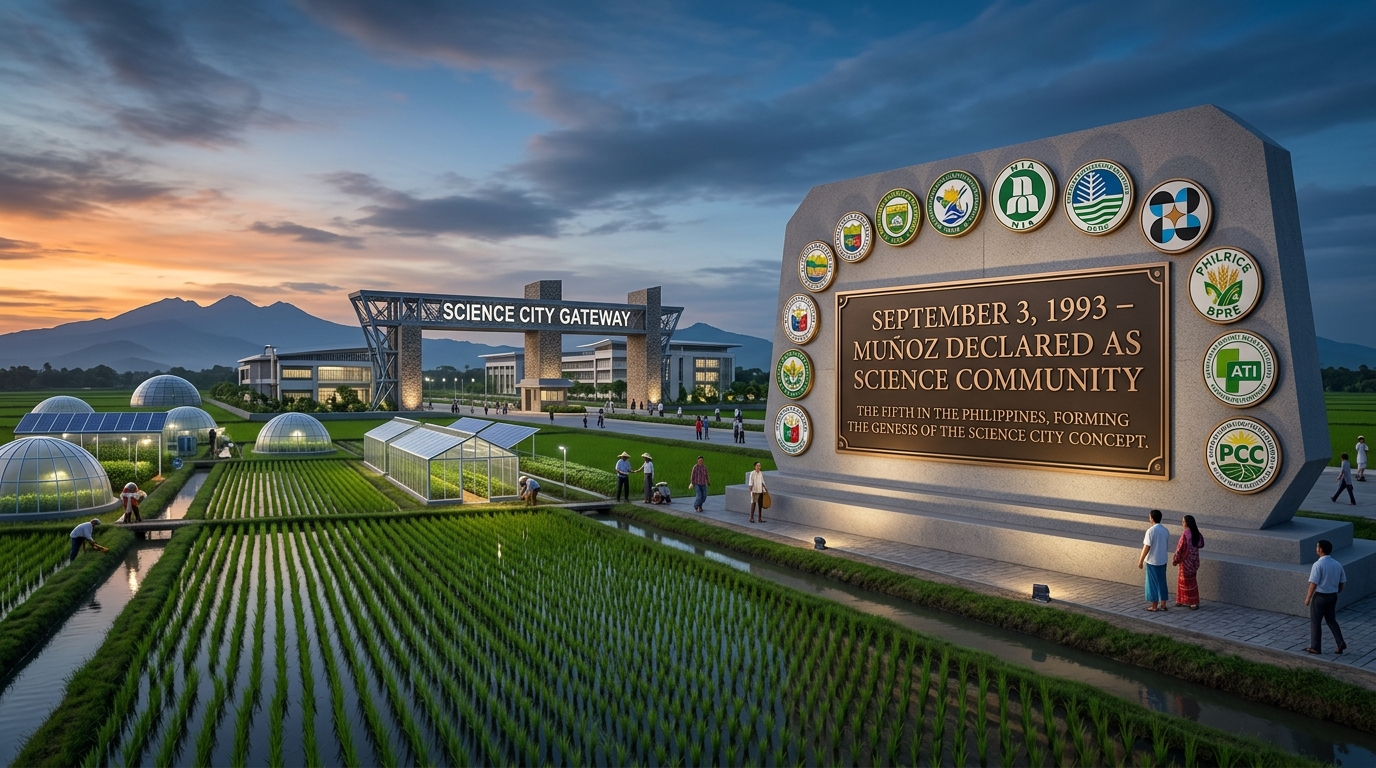
     Providentially, on September 3, 1993. Muñoz was declared by the Department of Science and Technology (DOST) as Muñoz Science Community owing to a large measure in the existence in the municipality of various state-of-the-art centers of excellence or research and  development agencies, foremost of which is the Central Luzon State University, a learning institution known far and wide.  This turn of event set into motion the creative mind of Mayor Efren L. Alvarez  to embark into the most
 ambitious plan of his career, that is to say, the creation of Muñoz into a Science City, the first-ever in the Philippines, and probably the second in the whole world after Tsukuba Science city in Japan.

     From that time on, Mayor Efren L. Alvarez practically did not give quarters for respite to his staff in the preparation of any and all attendant documents; personal representations to all concerned personages/agencies to justify the conversion of the municipality of Muñoz into a Science City.

Timeline

Moments from the record, in the order they happened.

  1. September 3, 1993

    September 3, 1993
    Muñoz was declared by the Department of Science and Technology as SCIENCE COMMUNITY the fifth in the Philippines where its original 12 member agencies are: LGU of Muñoz, Provincial Government of Nueva Ecija, CLSU, BFAR, NIA, DENR, DOST, PHILRICE, BPRE (formerly NAPHIRE), ATI, RCPC and PCC. It gave birth to the idea of converting Muñoz into a Science City.
  2. June 1995

    June 1995
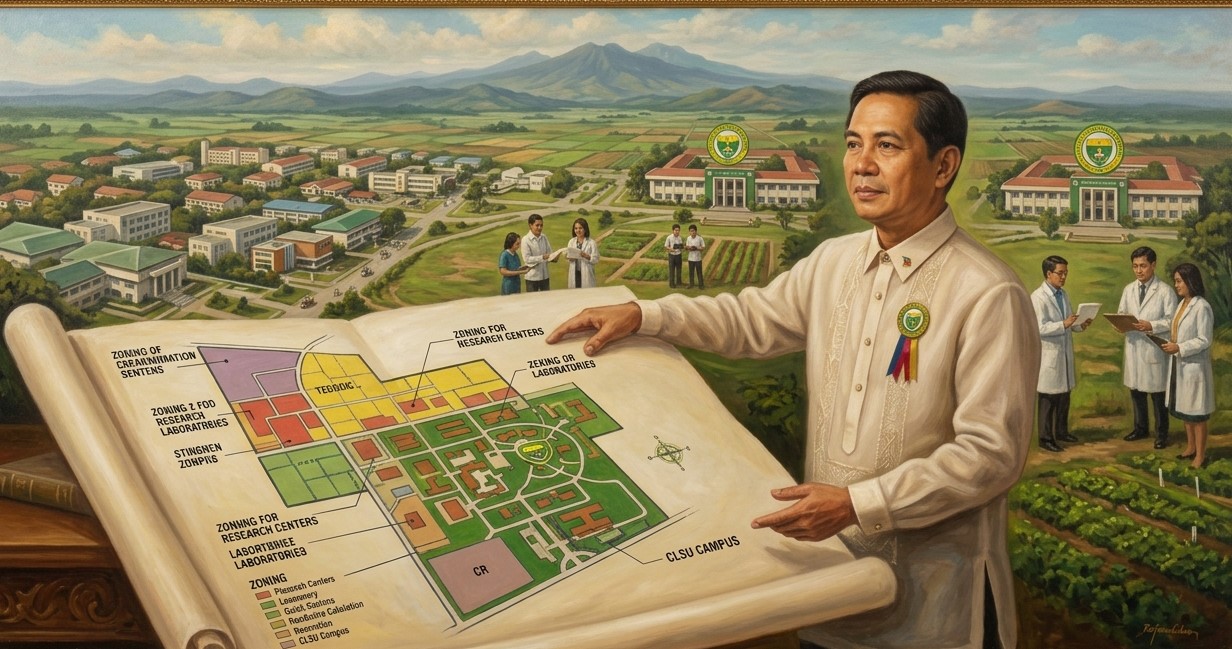
    Master Plan of Muñoz Science Community was formulated finalized by the Member–Agencies where the main author was Dr. Rodolfo C. Undan, then VP for Research & Extension now President of CLSU.
  3. September 15, 1995

    September 15, 1995
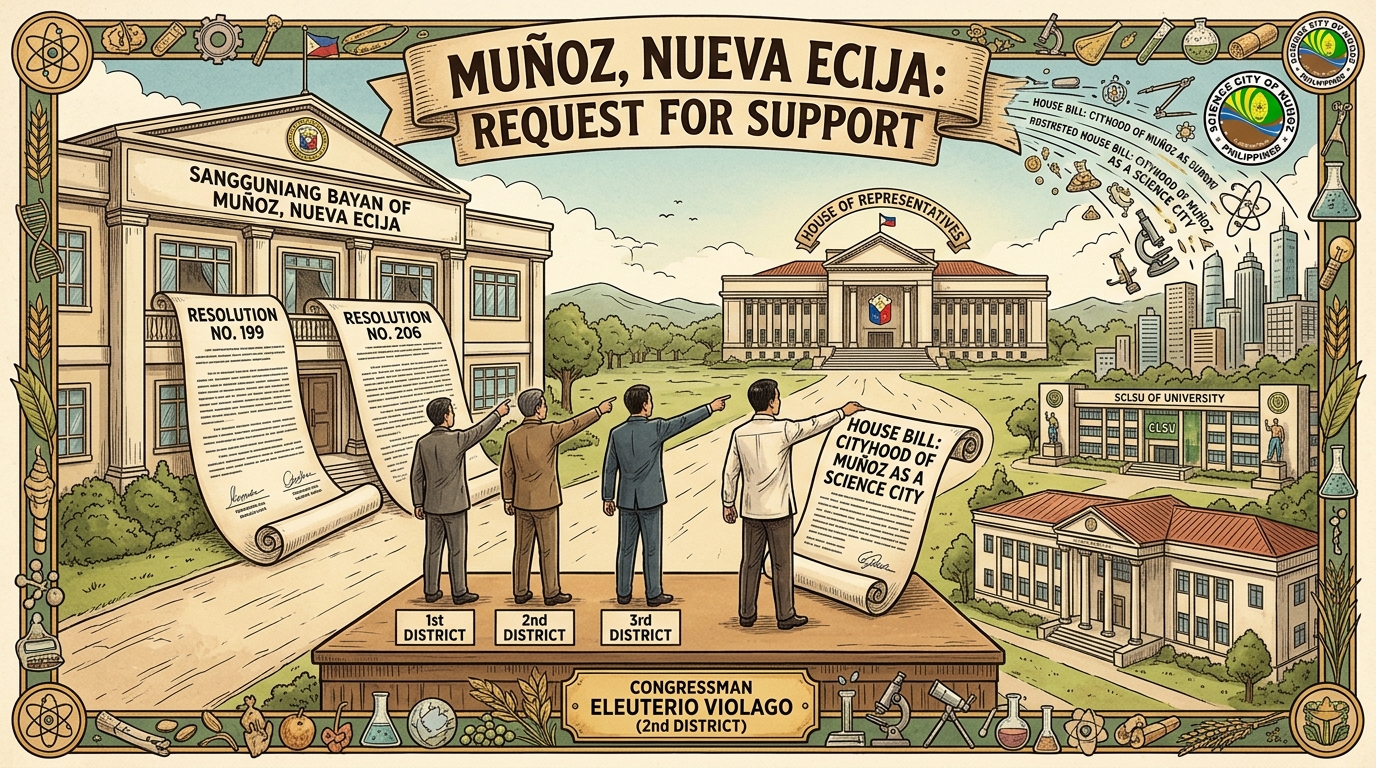
    Resolution Nos. 199 and 206 respectively were passed and approved by the Sangguniang Bayan of Muñoz, Nueva Ecija, essences of both are request for the assistance and support of the Four Representatives of the 4 congressional Districts of Nueva Ecija, especially Congressman Eleuterio Violago of the 2nd District to initiate/sponsor a House Bill for the cityhood of Muñoz as a Science City.

Oral stories

Accounts and recollections, in the words of the people who lived them.